Advancing Safety, Sustainability, & Innovation in Static Equipment Management

Workshop Brief :

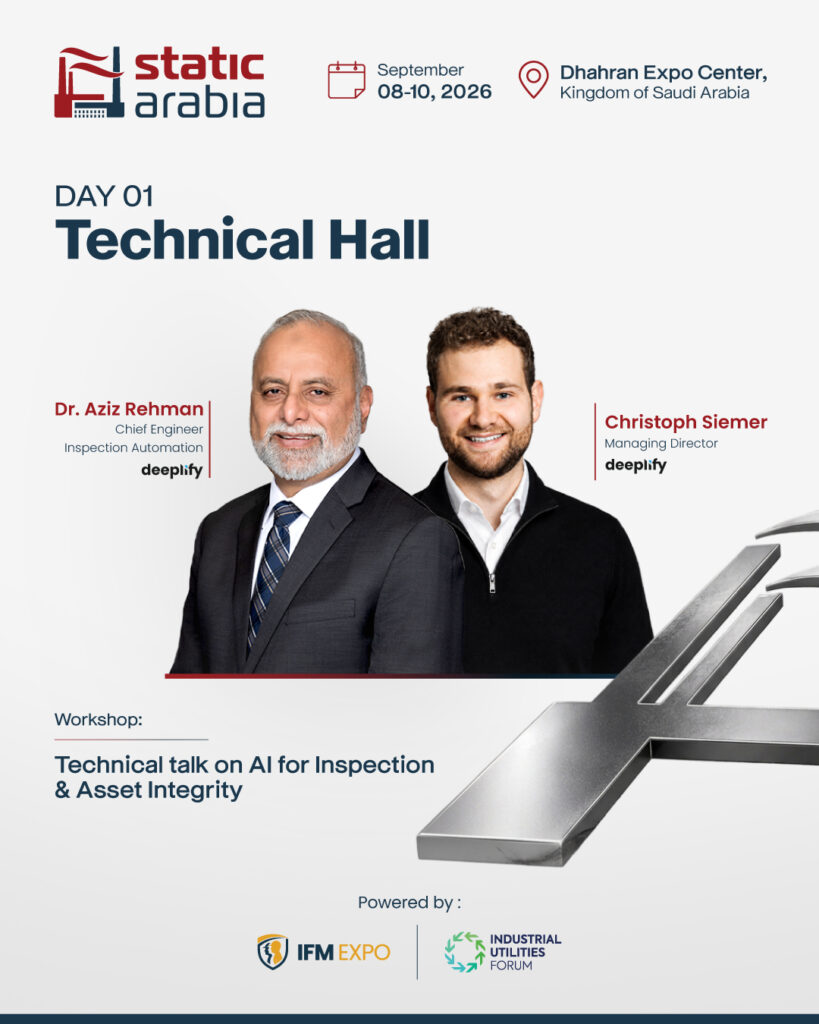
This interactive workshop on Auto RTFI explores how AI/ML can be applied to radiographic film interpretation for weld inspection. Built around the same three-phase workflow used in our joint qualification project with the Saudi Aramco Inspection Department, aligned with SAEP-1143 and reflected in our Static Arabia abstract, the session shows where automation adds value across the RTFI process.

The focus is on removing the highly repetitive 80-90% of work that is largely procedural: confirming area of interest, IQI placement, density, sensitivity, and other checklist-driven quality requirements. From there, the workshop shifts to the work that still depends on qualified human judgement: detecting, characterizing, and sizing indications, followed by interpretation and final disposition.

Rather than a conventional presentation, participants will take part in an interactive “You Be the RTFI” exercise, working through real scenarios against the actual SAEP-1143 checklist. We will then walk through the tool step by step, from project setup through to a reviewed and stamped radiograph.

The operational impact is significant. A film bundle disposition that may take an RTFI technician more than 20 minutes today can be completed by the AI/ML model in well under a minute, creating the potential for millions of dollars in savings at Saudi Aramco scale, while fully preserving the human review and sign-off required by current codes and standards.
Topic: ”AI-Assisted NDT & Asset Integrity: From Automation to Qualification”

The Human Factor in Radiographic Interpretation

In the oil and gas industry, best practice in nondestructive testing (NDT) requires that inspections be carried out by qualified personnel, and regulatory frameworks are designed specifically to guard against human error in interpretation. Even so, it would be misleading to assume these safeguards eliminate error entirely: RTFI (Radiographic Testing Film Interpretation) technicians are human, and their judgment can be influenced by fatigue, experience level, and state of mind. Studies confirm as much — even within a structured set of regulatory guidelines, the effectiveness of visual, human-led interpretation is not perfect.

Digitalization and the Case for AI/ML

As the industry advances toward Industry 4.0 and broader digitalization, digital radiography systems are becoming the norm, and the volume of digital weld radiographs produced is growing accordingly. This shift creates a natural opening to introduce AI/ML modules that ease interpretation backlogs, streamline project workflows, and support critical decision-making. Automating the recognition and evaluation of radiographic indications stands to do more than lighten the load on RTFI technicians — it can materially expand disposition throughput and reduce, or eliminate, the bottlenecks that inspection volumes currently create in project schedules, all while improving interpretation accuracy.

The Saudi Aramco – Deeplify Qualification Project

Building on this opportunity, and aligned with the revised Saudi Aramco Engineering Procedure (SAEP-1143), Deeplify and Saudi Aramco’s Inspection Department have launched a joint review and qualification project for Deeplify’s AI/ML-based Assisted Analysis software, with SAEP-1143 serving as both the technical foundation and the scope of work. Over several months, the assessment will scan and evaluate several thousand digital and digitized weld radiographs, checking film quality and the probability of defect detection to determine weld quality. Each radiograph is classified through a traffic-light system — “good,” “warning,” or “bad” — giving both organizations a consistent, auditable basis for comparing the AI model’s output against SAEP-1143 requirements.

Outlook

Taken together, the revised SAEP-1143 and the accompanying rise in digital radiography are creating the conditions for AI/ML-assisted analysis to move from pilot to standard practice. The Deeplify– Saudi Aramco qualification project is an early, concrete step in that direction: a rigorous, standardsbased validation of what AI/ML augmentation can mean for RTFI throughput, accuracy, and — ultimately — the pace of critical project decisions.